
Lowe’s Product Design: Cluster & Assortment Planning Tool
Project Brief
Overview:
The Cluster and Assortment Planning Suite (CAPS) is an internal product that allows Assortment Planners to create, maximize, and execute Product Assortment Strategies using store and population demographics cross-referenced with past sales data.
Problem Statement:
Assortment Planners must be able to manage variations of Workbooks, Clustering Methods, and Assortment Plans across the multiple Product Line Reviews (PLR) they work on at a time. At the end of a PLR, the Assortment Planner must decide which Clustering Method and Assortment Plan in the PLR best align with their merchant plans and optimize sales. The Assortment Planner must publish those into a single output, a Stocking Matrix, to the Central Stocking Governance product, for downstream teams to pick up.
Users:
Senior Assortment Planners | Assortment Planners
Who I Worked With:
Senior Product Manager | Product Managers | UX Architect | Senior Data Analyst | Developers | Primary Users
Scope & Constraints:
We had Q1 to complete end-to-end design, from discovery and user research, to design, user testing, and handoff. There was no researcher or content strategist available for this feature.
My Roles & Responsibilities
User Research
User Interviews
User Personas
Affinity Mapping
UX Architecture
Requirements
User Flows
Storyboards
Sketches
Testing Plans
UX Design
Lo-Fi Mockups
Hi-Fi Mockups
Prototypes
User Testing
User Testing Script
Task Scenarios
User Testing Prototype
Analyzation
Process
Discovery
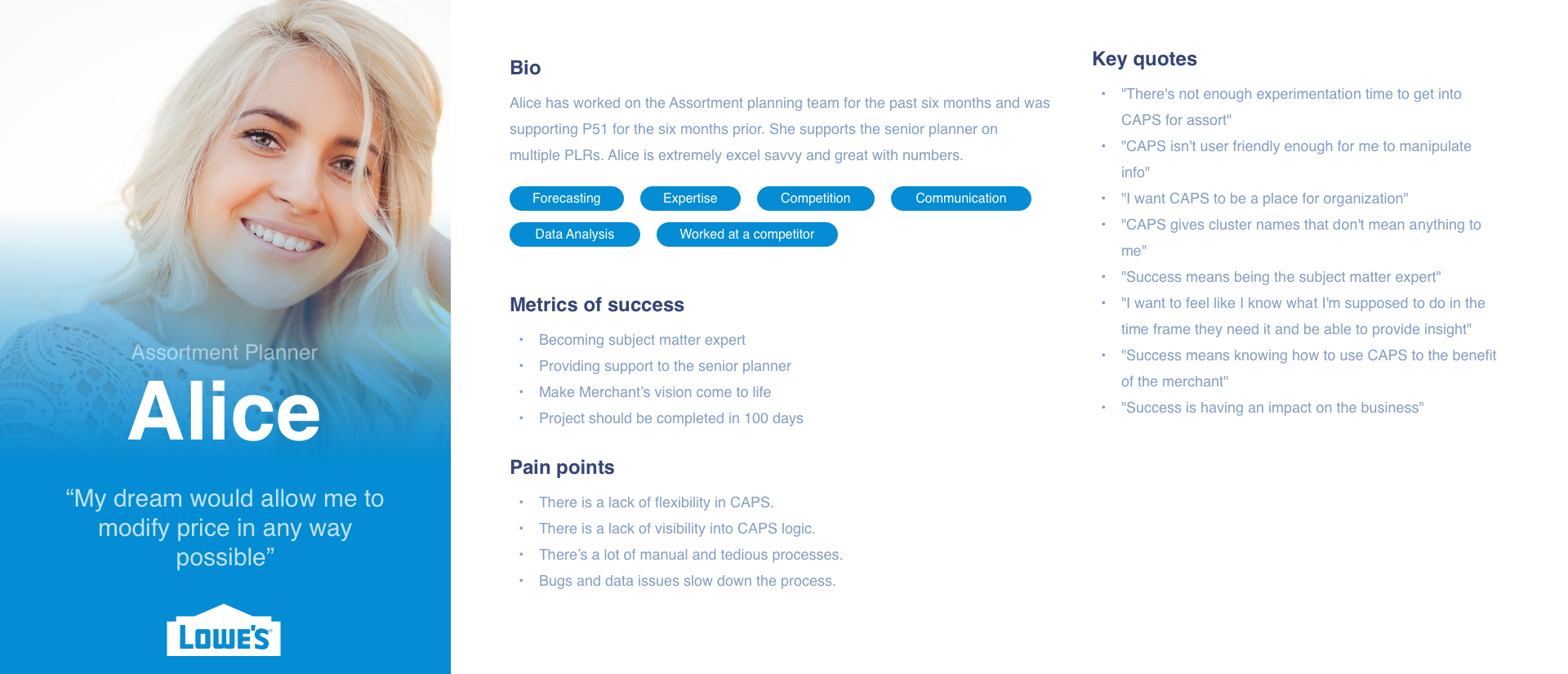
Since I worked on CAPS consistently, I had an established relationship with the users and was able to leverage user personas I had previously created. I scheduled one on one interviews with Primary Users, including Senior Assortment Planners and Assortment Planners to better understand the root of the problem. I created an interview script with open-ended questions that aimed at a few things:
How are they currently managing variations of Workbooks, Clustering Methods, and Assortment Plans across the multiple PLRs?
What are the pain points in the current workflow?
Are they leaving the CAPS application to accomplish anything in this workflow?
How are they deciding which versions of these outputs are best to include in the final product assortment strategy stocking matrix?
What is the hierarchy between Workbooks, Clustering Methods, and Assortment Plans?
What high-level metrics are most important when comparing variations of these outputs?
What happens after they publish a stocking matrix?
Are they keeping tabs on the status of decisions made by downstream teams?
After publishing, do they need access to their output variations?
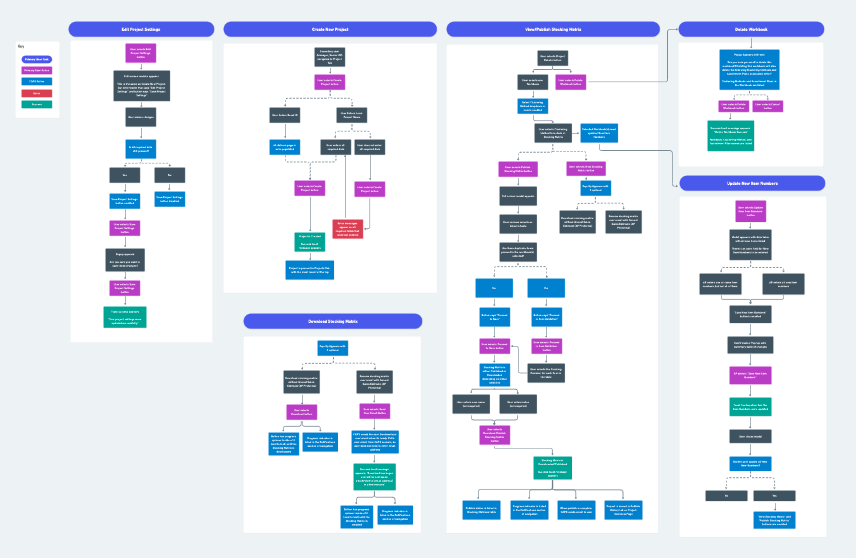
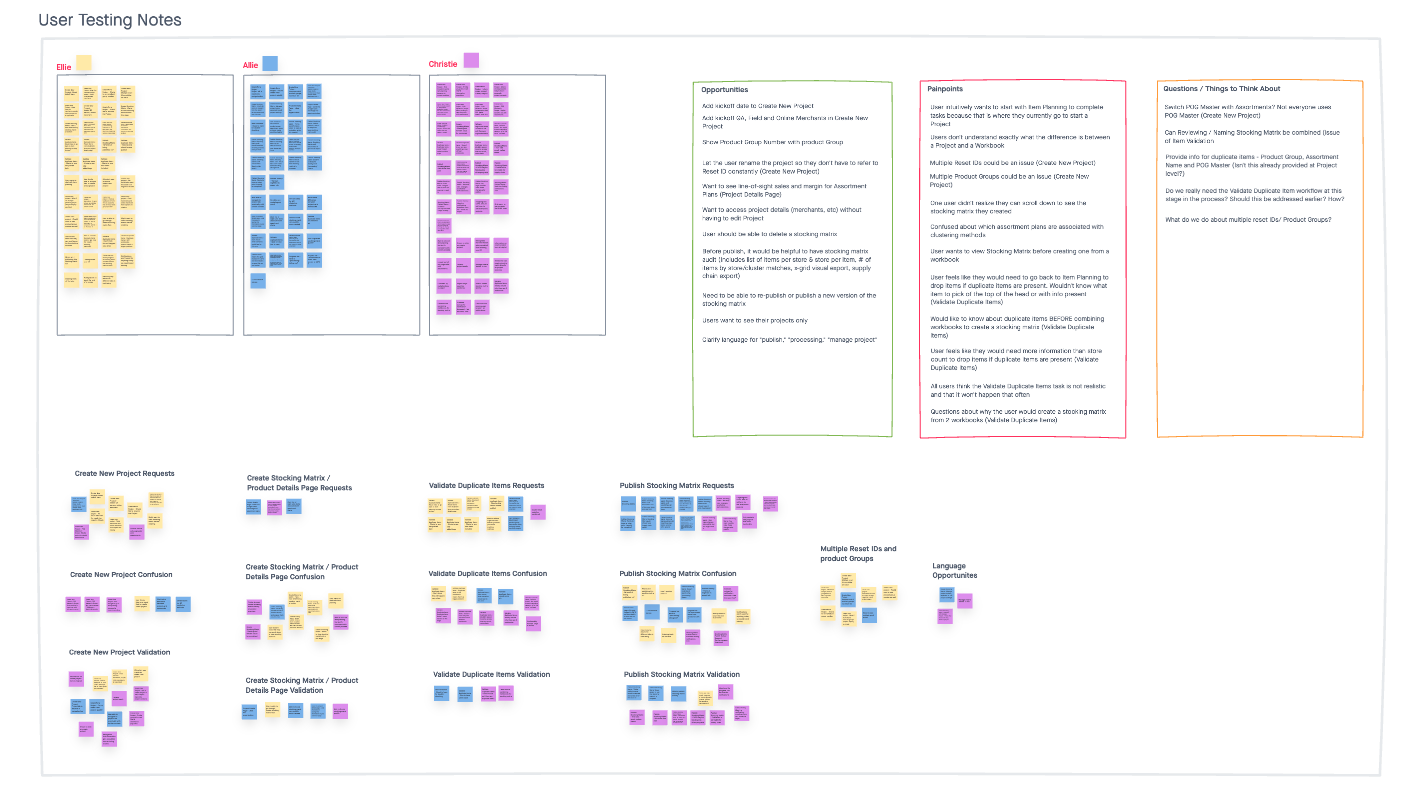
My UX Architect and I used InVision to aggregate our notes into an affinity map to document pain points, opportunities, and further questions. After a few follow-ups with users, I was able to put together a current user flow. This was helpful in both understanding the current workflow ourselves, and explaining the workflow to key stakeholders.
Architecture & Design
Next, I examined the current user flow with the user pain points and opportunities in mind. My UX Architect and I held whiteboarding sessions in InVision and further discussions with Product Managers and Users. We began researching solutions internally; looking for similarities in other Merch Tech products, as well as externally; looking into competitor analysis. Finally, I felt like I understood the problem and was ready to find a solution.
Validation
We took our users through our user flow map, validating our interpretation of their task and any painpoints they encountered.
Delivery
We collected our research findings to improve specific workflows, eventually creating low and high fidelity mockups. Because this is proprietary information I am unable to showcase what we were able to finally handoff.